
10/7/2026
When businesses talk about hiring people with disabilities, the conversation often begins with what a person might struggle to do.
What if we started somewhere else?
What are they good at? What do they enjoy? How do they learn? What kind of environment allows them to do their best work? What strengths could they bring to an employer if someone were willing to give them the opportunity?
Those are good questions to ask about a person with autism, ADHD, an intellectual disability, or another cognitive difference.
But aren't they also good questions to ask about
every employee?
We all have things we are naturally good at and things we aren't. Some people are great at public speaking but terrible at organization. Someone may be brilliant with numbers but struggle with people. One employee thrives under pressure while another needs time to process information. Some of us need written instructions. Others need to see something demonstrated. Some need quiet to concentrate, while others do their best thinking surrounded by activity.
We don't usually call those differences disabilities.
We call them people.
Maybe we need to think differently about THE word "Disability"
There are legitimate reasons the term
disability
exists. It can provide access to services, accommodations, legal protections, funding, and supports that people need. We should never minimize the very real challenges some people experience or suggest that everyone has the same support needs.
But there is a problem when the word becomes the first thing an employer sees. A diagnosis tells us surprisingly little about what someone can contribute to a workplace.
At
Dharma Dreams Vocational Center,
we work with young adults with moderate intellectual, developmental, cognitive, and learning differences. Many of those differences are invisible.
You may not immediately recognize that someone processes instructions differently, becomes overwhelmed when given several tasks at once, needs additional time to learn a new routine, struggles to interpret an ambiguous request, or becomes anxious when expectations suddenly change.
That doesn't mean the person cannot do the job.
It may mean we need to get better at
teaching the job.
And that distinction matters.
Neurodiverse hiring is not charity
Hiring neurodiverse employees should not be viewed as an act of charity or simply something a company does to demonstrate corporate social responsibility.
Businesses need employees who are dependable, engaged, productive, willing to learn, and capable of contributing to the organization.
Neurodiverse people want meaningful work, purpose, independence, income, connection, and opportunities to contribute.
Those goals can meet.
A neurodiverse employee may bring attention to detail, consistency, persistence, creativity, loyalty, specialized interests, a different approach to problem-solving, or a willingness to do work that perfectly matches their strengths.
But just like every other employee, the right person needs to be matched with the right job.
Inclusive hiring isn't about lowering expectations. It is about creating better pathways for people to meet them.
Sometimes THE biggest ACCOMMODATION is patience
When people hear the phrase
workplace accommodations,
they may picture expensive equipment, extensive modifications, or complicated HR requirements.
Often, the changes that help an employee with a moderate cognitive disability are much simpler.
An employer might provide written instructions in addition to verbal directions. A supervisor might demonstrate a task rather than simply explain it. A complicated assignment can be broken into smaller steps. Checklists can help employees remember a sequence. Expectations can be stated clearly rather than implied. New employees can receive additional practice before being expected to work independently.
And sometimes someone simply needs to hear:
Let's try that again.
Patience
can be one of the most powerful workplace accommodations there is.
It may take someone longer to learn a task. But taking longer to
learn
something does not necessarily mean someone will be less capable of
doing
it once they have learned it.
That is a distinction employers need to understand.
Here's the really interesting part: Everyone benefits
This is where
neurodiversity in the workplace
becomes much bigger than disability inclusion.
Imagine a manager learns to give clearer instructions because one neurodiverse employee needs them.
Who benefits?
Everyone.
Suppose a business creates written procedures, visual instructions, predictable routines, checklists, better onboarding, clearer expectations, regular feedback, and more thoughtful communication.
Those practices may have been introduced to support an employee with a cognitive difference.
- But the new employee fresh out of high school benefits.
- The employee whose first language isn't English may benefit.
- The person returning to the workforce after ten years may benefit.
- The overwhelmed employee having a difficult week may benefit.
- The seasoned employee learning a completely new process may benefit.
- And the manager benefits because fewer things get lost in translation.
Inclusive workplace practices are often simply good management practices.
That is one of the great misconceptions about hiring people with disabilities. Employers sometimes assume inclusion means changing an entire workplace for one person.
Very often, making the workplace work better for that one person makes it work better for everyone.
The invisible middle deserves more attention
There is a population that can easily be overlooked in conversations about
disability employment and workforce development.
These are young adults who may not require intensive one-to-one support but who also may not yet be ready to walk into a traditional workplace and immediately succeed without additional preparation, coaching, patience, and understanding.
- Their challenges may not be obvious.
- They can fall into an uncomfortable middle.
- They are capable of learning.
- They are capable of contributing.
- They are capable of meaningful employment.
- But capability and readiness are not always the same thing.
That is one reason vocational training for young adults with intellectual and developmental disabilities needs to address far more than the technical requirements of a job.
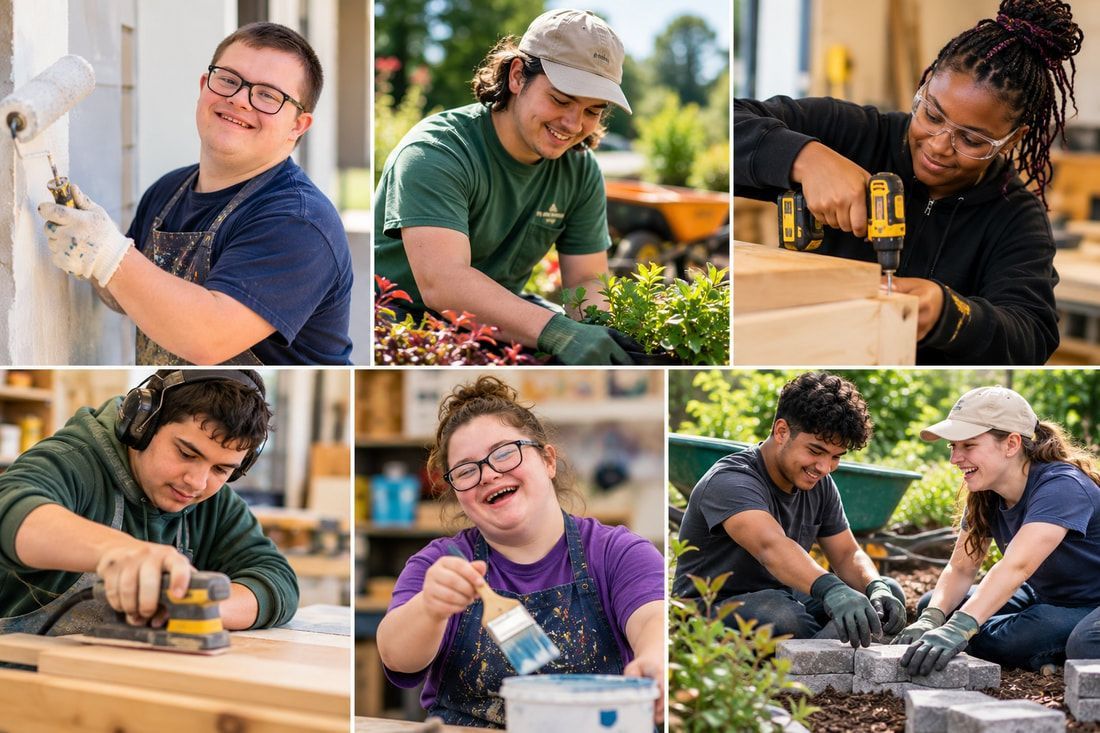
At Dharma Dreams Vocational Center, our approach combines hands-on vocational training with communication, emotional regulation, teamwork, problem-solving, workplace behavior, confidence, independence, and other skills that help someone succeed beyond the classroom.
We want our students to learn how to work.
But employers also have a role to play in learning
how to work with them.
Inclusion is a two way street
We spend considerable time preparing neurodiverse individuals to enter the workforce.
Maybe we should spend more time preparing the workforce to welcome neurodiverse individuals.
That means educating supervisors. It means questioning assumptions. It means understanding that communication differences are not necessarily attitude problems. It means recognizing that someone who needs clarification isn't necessarily incapable. It means allowing people enough time to show what they can do.
And it means focusing less on labels and more on the individual standing in front of us.
Instead of asking:
What is this person's disability?
Try asking:
What does this person need in order to be successful here?
Then ask the same question about every employee.
You might be surprised by how similar the answers are.
The win-win-win of Neurodiverse employment
When we get this right, there are at least three winners.
The individual wins
by gaining skills, income, confidence, purpose, independence, relationships, and the dignity that can come from meaningful work.
The employer wins
by gaining access to an often-overlooked talent pool while developing stronger training, communication, onboarding, and management practices.
The community wins
when more people have opportunities to participate, contribute, earn income, develop relationships, and be recognized for what they can do rather than defined by what they cannot.
That's the real opportunity behind
neurodiverse hiring.
Maybe the goal isn't to build workplaces that are better at accommodating people with disabilities. Maybe the bigger goal is to build workplaces that are better at understanding
people.
Because every one of us comes to work with strengths, weaknesses, preferences, challenges, talents, fears, and different ways of learning.
The differences may be more visible in some of us than others....But different doesn't mean less capable.
Sometimes it simply means we need to teach differently, communicate more clearly, exercise a little more patience, and give someone the opportunity to show us what they can do.
And when businesses do that, everybody can win.
0 Comments